Sunday, February 25, 2024


Money management for kids: Early exposure shapes financial habits


Real-world, hands-on experiences teach kids valuable financial lessons as they watch their money work for them, helping them achieve their goals, whether it's saving for college, or even their first car.

Money management is an essential life skill, yet it isn’t a part of our formal educational curriculum. Children usually pick up money management habits from their parents, and it is therefore critical that parents promote financial education from a very early age.

Here’s how you can make financial literacy fun for your kids through simple activities:

Understanding money (age 4-5 years)

Teach them the value of coins and let them sort coins. This will not only help them understand what money is, but also learn how to count it. Tried and tested concepts like piggy banks help kids familiarise themselves with money at a young age.

Earning their allowance (age 6–10 years)

Teaching your kids the value of earning money from a young age is critical, because it helps them understand the concept of income, budget, and living within their means. Let them earn their allowance by conducting simple tasks like cleaning their room, assisting you with grocery runs, etc.

Learning about banking (age 11–14 years)

Ease your kids into understanding the concepts of savings, investment, taxation, and more. If your child has saved up from their allowance, give them an incentive to retain their savings instead of spending it.

For every Rs 1,000 they save, contribute Rs 50, emphasising the idea that savings can lead to greater financial outcomes. It also simplifies the concept of compounding for them, because an interest of Rs 50 each month motivates them to save the money for a longer period.

Learning about investing (age 15-18 years)

Help your child start a systematic investment plan (SIP), which allows them to regularly invest a portion of their saved money. Explain how the money they invest will grow over time. You can make investing more engaging by purchasing shares of a company they are passionate about, effectively making them part owners of that company.

These real-world, hands-on experiences teach kids valuable financial lessons  as they watch their money work for them, helping them achieve their goals, whether it's saving for college, or even their first car.

Message to parents

It is important to cultivate the right financial habits in your children from a young age. This includes speaking openly and frankly about money. The world we live in is increasingly promoting spending patterns that can lead to harmful money habits.

A classic example is the option of ‘buy now, pay later.’ These things lead to individuals prioritising an unaffordable and unsustainable lifestyle over the longer term.

Consumption spending has become the norm, which could lead to an uncertain financial future due to lack of financial discipline. Unless your child has understood the upsides and downsides of money management, they can’t be in a position to make well-informed financial decisions as adults.


What is QIP, why is it a preferred route for companies to raise funds

With the stock market booming, many companies are rushing to raise capital for a variety of purposes. The Qualified Institutional Placement (QIP) route is turning out to be the preferred route for most firms llooking to raise capital. This explainer decodes the QIP and why companies like it better compared to conventional routes like follow-on public offering (FPO) or a rights issue.

First up, what is QIP?

It is a capital-raising tool allowing listed companies to raise funds from qualified institutional buyers (QIBs) by issuing fresh equity shares, fully and partly convertible debentures, or any securities other than warrants convertible to equity shares.

Who are these Qualified Institutional Buyers (QIBs)?

Public financial institutions, scheduled commercial banks, mutual funds, insurance companies, foreign portfolio investors and foreign institutional investors.

Can retail investors and high networth individuals (HNIs) invest in a QIP?

No.

Why is QIP attractive to companies?

Because it helps them avoid the lengthy and complex processes of an FPO or rights issue. Also, since QIBs are sophisticated investors, they have a long-term perspective, which helps in price stability.

Can promoters participate in a QIP?

No.

Are there rules on the minimum number of institutional buyers that should participate in a QIP?

If the issue size is more than Rs 250 crore, there should be at least five buyers. Any single buyer cannot be allotted more than 50 percent of the stake. If the issue size is up to Rs 250 crore, there should be at least two buyers.

What is the basis for pricing of a QIP?

Under SEBI regulations, the issue price should be not less than the average of the weekly high and low of the closing prices over the past couple of weeks.

Why can’t it be less than the average?

There have been allegations in the past that promoters were allotting shares to their favoured investors cheaply. The QIP price has a bearing on the stock’s market price.

Can the QIP issue be priced at a premium to the market price?

Yes, it can be. But QIBs typically ask for a discount. That is one of the reasons they participate in such a placement. They can get a good quantity without driving up the stock price, unlike buying in the open market.

What if a QIB does not have a long-term view and wants to sell the next day after being allotted the shares?

It can’t. Securities allotted in a QIP are subject to a lock-in period of six months from the date of allotment. This is intended to ensure that only QIBs with a medium to long-term view participate in the issue.


Saturday, February 17, 2024


What is Asset Allocation?

When it comes to investing, you can only rely completely on any single type of asset. Instead, it’s better to spread your money into different types of investments, like stocks, mutual funds, bonds, and real estate. It helps reduce the risk of losing all your money if one investment doesn’t do better.

In this blog, we will discuss asset allocation, the types of assets you can invest in, the key asset allocation strategies, and how you can choose an asset allocation strategy that is right for you.

What is Asset Allocation?

Asset allocation is the investment strategy to balance risk in which you allocate your money to multiple asset classes, such as equity, debt, stocks, and gold. The primary purpose of asset allocation is to ensure that your portfolio performs well under different market conditions. This can be done by ensuring you have a diversified portfolio of different asset classes, as no asset class performs well at all times.

Importance of Asset Allocation

Asset allocation is important for several reasons:

  • Risk Management: By diversifying investments across various asset classes, you can easily reduce the risk in the overall portfolio, as the performance of your portfolio is not dependent on one asset class.
  • Enhanced Returns: You are expected to earn better risk-adjusted returns if you allocate assets per your financial goals and risk tolerance. 
  • Achieve goals: Asset allocation strategies helps you in achieving your financial goals as it spreads your investments across different types of assets considering your risk-taking ability. 
  • Avoiding Concentration Risk: Spreading investments across different assets prevents overexposure to any single asset, reducing the potential negative impact of a poorly performing investment.

Different Asset Classes

The 4 main asset categories available to Indian investors are:

  • Equities: Under the equity asset class, you directly invest in any listed company. In return for your investment, you receive shares of the company. These are considered more risky investments due to their volatility. Equity-oriented investments include equity mutual funds and stocks. 
  • Fixed Income: Fixed income asset class is considered low-risk investments, giving you a regular income over the investment period. It includes FDs, money market instruments, corporate bonds, government bonds, etc. 
  • Real Estate: Real estate can offer attractive returns through property appreciation and rental income. It includes investment in residential or commercial buildings, lands, etc. But to invest in real estate, you need a big corpus. Also, real estate investments are less liquid than other investments, as you can not sell them at any time or a fraction of them. 
    Another option is REITS (Real Estate Investment Trusts ), wherein you invest in real estate without owning any physical properties. You earn regular income through dividends/interest payouts and also earn potential capital gains at the time of selling it. 
  • Gold: Having Gold in your investment portfolio is beneficial because it lowers risk through diversification.
    Gold and stocks usually move in opposite directions. This means that when stock markets go down, the price of Gold tends to go up, and when stock markets rise, the price of Gold tends to fall. As a result, Gold acts as a hedge against volatility in the stock market. However, it’s important not to put more than 5-10% of your total portfolio in Gold.

But these are not the only asset classes that you can invest in. You also have the option of investing in asset classes like international equities, infrastructure projects (through infrastructure investment trusts), and even commodities like silver (through silver ETFs), cotton, zinc, etc. However, you can’t randomly choose to invest in any asset class. The choice of assets to diversify your portfolio and how much you should allocate would depend on your asset-allocation strategy. Let’s briefly understand what these strategies are.

Asset-Allocation Strategies

There is no one-size-fits-all approach to asset allocation, as every investor is unique regarding their investment goals, risk tolerance, age, financial responsibilities, etc. But apart from these investor-specific factors, external factors like market movements, changes in interest rates, etc., might necessitate a periodic change in the asset-allocation strategy. There are 4 key types of asset-allocation strategies:

Strategic Asset Allocation

Strategic asset allocation involves determining and maintaining an appropriate ratio of various asset classes in the investor’s portfolio. This appropriate mix of various asset classes in the investor’s portfolio is determined based on factors such as the investor’s age, risk profile, etc. In this type of asset allocation, periodic portfolio rebalancing is performed to ensure that the proportion of individual assets in the portfolio is maintained at the pre-determined levels.

For example, under the auto-choice option of the NPS, investors can choose the maximum equity allocation between 25% to 75% till 35 years of age. However, after the investor achieves 35 years of age, the equity allocation of the portfolio is reduced by a fixed percentage every year. Therefore, the NPS asset allocation is strategically changed as per the investor’s age.

Tactical Asset Allocation

The tactical asset allocation strategy involves tactically changing the proportion of different asset classes in an investor’s portfolio to take advantage of changing market conditions. The main aim of this is to benefit from relatively short-term bullish and bearish conditions in equity and debt markets.
An example of this can include increasing equity allocation in the investment portfolio for the short term during a market downturn to benefit from the lower prices of quality stocks. When markets recover later, these stocks can be sold at a profit to generate higher returns for the investor.

Dynamic Asset Allocation

Dynamic asset allocation is similar to tactical asset allocation as it also focuses on changing the short-term allocation of different asset classes to take advantage of changing market conditions. However, unlike tactical asset allocation, which involves buying and selling investments manually, dynamic asset allocation is performed using automated systems based on financial models. Investors who want their portfolios managed using dynamic-asset-allocation techniques can opt to invest in balanced advantage funds, also known as dynamic asset-allocation funds.

Age-Based Asset Allocation

Age-based asset allocation strategy considers your age as the key factor in determining your equity mutual fund allocation. Under this strategy, your equity allocation is determined by subtracting your current age from the 100. 

For example: If you are currently age 25, then you can have 75% (100-25) equity in your portfolio, and 25% remaining can be debt or any other asset class.

Factors Affecting Asset Allocation

There is a belief that investors must follow standard rules for asset allocation and that the rules are the same for all investors. However, this is not true. Asset allocation varies from investor to investor.

So, how should you decide your asset allocation? Well, one of the most important factors is your risk profile. Every individual’s risk profile is different, and owing to this, the standard rule of asset allocation shouldn’t be used.

Understanding Your Risk Profile

To understand your risk profile, you need to understand three components that constitute your risk profile – risk appetite, risk capacity, and risk tolerance.
You might think of these terms as the same, but you must note that there is a difference between each of these.

  1. Risk appetite is how much risk you are willing to take.
  2. Risk capacity is how much risk you can take. Although you might be willing to take the risk on your entire capital, your current financial situation, including liabilities, dependents, age, and salary, might not allow you to do that. So, you need to consider these before defining your risk capacity.
  3. Risk tolerance is how much risk you can tolerate mentally. For example, if you invest in the stock market, where there are a lot of fluctuations, you must be mentally prepared to tolerate the risk.

Of these three components, risk tolerance is most critical while determining your asset allocation. That’s because you might have a high-risk appetite and risk capacity, but your risk tolerance will determine which asset classes and investment options you pick.

As you allocate assets based on risk tolerance, you must consider personal factors like your monthly income, expenses, age, financial liabilities, your dependents in the family, etc.

Need for Asset Rebalancing in Asset Allocation

Another important factor to consider with asset allocation is rebalancing. It refers to the buying or selling of assets in a portfolio to maintain a balanced level of risk.

For example, suppose your investment portfolio has 45% of your assets allocated to equity, 45% to debt, and the remaining 10% to gold. Now, assuming that the markets are performing well and you make profits on your equity investments, the allocation to equity in your portfolio increases to, let’s say, 52%. Now, because you earned profits on one asset class in your portfolio, the share of the other asset classes would automatically reduce. Since you have earned profits from your equity investments, you can now use those profits and allocate more funds to other asset classes in your portfolio that now have a lesser allocation in your portfolio. This rebalancing will ensure that the asset allocation in your portfolio is again balanced as you originally planned, thereby mitigating the risk.

Note that if you do not rebalance your portfolio, it will be skewed towards one particular asset class and this will increase the risk involved in your investments. For instance, if you favor equity investments, you would start investing more funds in equity. But this may eventually increase the risk involved in your investments.

How to Choose the Right Asset Allocation Strategy

We all have unique goals in life. They define our investment horizons as well as risk tolerance. Therefore, the ideal asset-allocation strategy must be customized to each of the unique needs. The asset mix for each goal should be aligned to risk tolerance, which can change over time due to factors like evolving goals, increase or decrease in income, etc. Therefore, you also need to periodically review your portfolio and rebalance it to ensure you are on track to reach your goal. 

 These 6 investment strategies allow you to invest in customised investment portfolios of mutual funds or stocks and ETFs uniquely suited to your investment needs. These customised investment portfolios ensure you are invested in the correct proportion in different asset classes like domestic equities, debt, gold, and international equities.
Beyond the initial investment selection, Genius will also use dynamic-asset-allocation strategies to determine the best time to enter into and exit from each asset class through one-tap monthly rebalancing of your portfolio. This allows Genius to increase your allocation in different asset classes or even bring it down to zero based on the prevailing market conditions. This way you are assured of optimal returns while never exceeding the overall risk tolerance of your portfolio.

We hope you found this article useful. If you did, please share it with your friends and family and help us reach more people. If you have any questions or need clarification on what we have written in this blog, ask us in the comment section below, and we will respond.


Regards

Mahesh pv

FinCARE PORTFOLIO

989515301
Saturday, December 23, 2023


Flexicap Mutal Funds , SIP And Lumsum for long term wealth creation

Flexicap funds are diversified equity mutual fund schemes which can invest across market cap segments. There are no upper or lower limits with respect to allocations to any market cap segment. The fund managers of these schemes can invest any percentage of their assets in any market cap segment viz. large cap, midcap and small cap according to their market outlook.

Difference between Flexicap and Multicap Funds

Sometimes investors get confused between flexicap and multicap funds because there are certain similarities between the two categories. But there is an important difference which you should remember. Multicap funds must invest minimum 25% each in large cap, midcap and small cap stocks. In other words, at any point, multicap funds will have minimum 50% allocation to midcap and small caps. Flexicap funds, on the other hand, have no market cap restrictions. They have the flexibility to allocate any percentage of their portfolio to any market cap segment.

You may like to read what is the difference between multi cap and flexi cap mutual funds?

Why invest in Flexicap Funds?

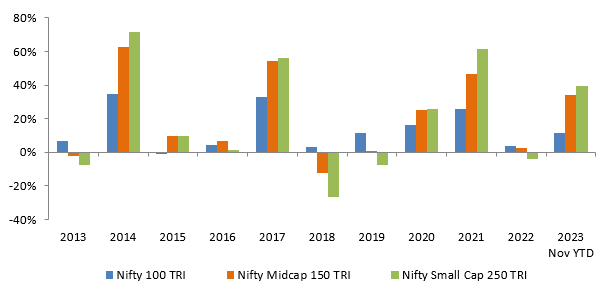
  • Winners rotate across market cap segments: One market cap segment cannot keep outperforming or underperforming for a long time. Historical data shows that winners rotate across different market cap segments – see the chart below. Flexicap fund managers can create alphas by prudently rotating allocations to different market cap segments based on their outlook.

    Winners rotate across market cap segments

    Source: NSE,  (as on 30th November 2023). Large Cap: Nifty 100 TRI, Midcap: Nifty Midcap 150 TRI, Small Cap: Nifty Small Cap 250 TRI. Disclaimer: Past performance may or may not be sustained in the future.


  • Greater scope of alpha creation in mid / small caps compared to large cap funds: The chart below shows the annual category average returns of Large Cap and Flexicap Funds over the last 5 years. Large cap funds invest at least 80% of their assets in large cap stocks. Large cap stocks have high percentage of institutional ownership, are more researched and therefore have better price discovery. Hence scope of alpha creation is less in large cap compared to midcaps and small caps, which are less researched. Fund managers may be able to find quality mid and small cap stocks at attractive valuations, thereby creating alphas for investors over long investment horizons.

    Annual category average returns of Large Cap and Flexicap Funds over the last 5 years

    Source: (as on 30th November 2023). Disclaimer: Past performance may or may not be sustained in the future.


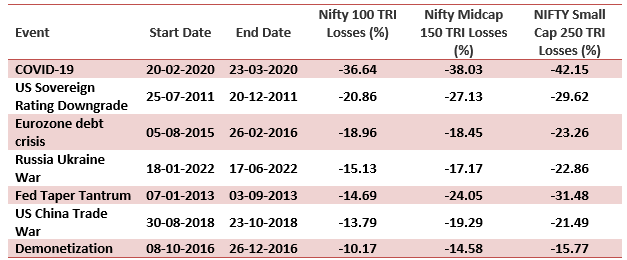
  • Less volatile than mid and small caps: The below shows the biggest drawdowns of the last decade. You can see that large caps experienced smaller drawdowns compared to midcaps and small caps. While mid and small caps tend to outperform large caps in bull markets, they tend to much more volatile than large caps. Flexicap Fund managers have the flexibility to quickly shed risks in volatile markets and reduce volatility for investors.

    Biggest drawdowns of the last decade

    Source: National Stock Exchange,  (as on 30th November 2023). Disclaimer: Past performance may or may not be sustained in the future.


  • Ideal for retail investors: Prudent financial planning calls for diversification across all asset categories. While more experienced or informed investors can decide how much exposures they want to large caps, midcaps and small caps in their investment portfolios, Flexicap Funds are ideal for investors who are not able to decide how much allocations they should have towards each market cap segments and want the fund managers to decide on market cap allocations. A large majority of retail investors may fall in the second category. Flexicap Fund managers aim for long term capital appreciation while trying to limit downside risks in the short term.

Why Flexicap makes sense in the current market landscape?

As mentioned before, market sentiments are bullish currently. With Lok Sabha elections scheduled in the summer of 2024, a pre-poll rally also cannot be ruled out. Historical data suggests that, in bull market phases valuations of midcap and small cap stocks tend to get overheated (midcap and small cap indices have gone by 42% and 46% this year) unless supported by earnings. On the other hand, there is potential for further upside if earnings growth outlook improves further. In the current market landscape a flexicap strategy, where the fund manager has the flexibility to investment across market cap segments as per market outlook may be suitable for long term investors.

Who should invest in Flexicap Funds?

  • Investors who want capital appreciation over long investment horizon.

  • Investors with high to very high-risk appetites.

  • Investors who have at least 5 years plus investment tenures.

  • They are suitable for investors who want to invest from their monthly savings through SIP for their long-term financial goals like children’s higher education, marriage, retirement planning, wealth creation etc.

  • You can also invest in lump sum if you ready to remain invested for the long term.

You should consult with your financial advisor or mutual fund distributor, if Flexicap Funds are suitable for your investment needs.

Mutual Fund Investments are subject to market risk, read all scheme related documents carefully.

whatsapp sharing button

Sunday, December 17, 2023


Gold Bonds vs. Mutual Funds: Making the Right Choice

If you wish to achieve long-term financial goals, investing in financial instruments is crucial. In India, Gold Bonds and Mutual Funds are popular investment choices, and each comes with its own set of benefits and suitability for various investment objectives. However, choosing between the two can be an incredibly daunting task. Therefore, this blog post aims to compare these two investment options and provide you with the necessary guidance to select the most suitable option for your specific needs.

What are Sovereign Gold Bonds?

Gold bonds are an excellent choice for investors seeking a low-risk investment option. These bonds are backed by the Government of India, ensuring a safer investment choice with minimal risk of default. Sovereign Gold Bonds are government securities expressed in grams of gold i.e. 1 unit of Sovereign Gold Bond is equal to 1 gram of gold.

Investing in Gold Bonds through the SGB Scheme


– The Sovereign Gold Bond (SGB) scheme is a government initiative to encourage investors to invest in gold bonds.

– SGB scheme offers a lower cost of investing in gold, a fixed interest rate, and a tax-free return on investment if held till maturity.

– Investors can invest in gold bonds at a discount of Rs.50 per gram, if applied through online mode, making it a cost-effective option.

– It also offers a fixed interest rate of 2.5% per annum, paid semi-annually, providing a fixed income stream for investors in addition to capital appreciation in the prices of gold.

– Investors who hold gold bonds until maturity are eligible for a tax-free return on investment, reducing their tax liability.

Why Invest in Gold Bonds?

Gold bond investments are becoming more popular in India due to their unique features. The government issues these bonds allowing investors to invest in gold without worrying about storing or securing it themselves. Gold bonds are a relatively new investment option in India, but they offer a promising opportunity.

Crucial Facts to Consider Before Investing in Gold Bonds

  • Gold bonds can be bought in paper or demat form from bse/nse platform, banks, post offices, and stock exchanges.
  • The minimum and the maximum investment is one gram and four kilograms for individuals and Hindu Undivided Families (HUFs), respectively. Further, the maximum limit is 20 kgs for trusts and similar entities as notified by the government from time to time.
  • The tenure is eight years, but investors can exit after the fifth year.

How to Buy Gold Bonds

  • Gold bonds in India can be bought from  banks, post offices, and stock exchanges.
  • The price of these bonds is tied to the current market value of gold.
  • Gold bonds can be purchased at the same price as physical gold.
  • Investors can buy gold bonds online through the Reserve Bank of India’s website as well.
  • This method is convenient as investors can pay through net banking or debit cards.

As an investor, you must understand the process of purchasing Gold Bonds. Additionally, It should be emphasized that sovereign gold bonds can serve as collateral security for availing loans from banks and financial institutions. The loan-to-value ratio will be the same as the standard requirements set by the Reserve Bank of India, similar to any ordinary gold loan.

Understanding Mutual Funds

In India, investing in mutual funds is a popular option because of its numerous benefits. These funds are spread out investments across various assets like stocks, bonds, and commodities to diversify them.

Here is a summary:

– Investors can invest in mutual funds through banks, online platforms, and mutual fund distributors.

– Mutual funds offer diverse options, such as equity funds, debt funds, and hybrid funds.

– Asset diversification is a significant advantage of investing in mutual funds, minimizing the risk of investing in a single asset class.

Additionally, investors can take advantage of the knowledge of well-trained fund managers since professionals manage mutual funds. Given the expansion of the Indian economy and the rise in the number of investment options in the market, mutual funds are expected to continue being a preferred choice for investors in India.

Gold Bonds vs. Mutual Funds: Key Factors to Keep in Mind When Comparing

If you’re trying to decide between gold bonds and mutual funds, weighing their respective benefits and drawbacks is essential. Ultimately, what’s right for you will depend on your goals and how much risk you’re ready to handle.

Returns and Risk

  • Gold bonds offer a fixed interest rate of 2.5% per annum, paid semi-annually over and above the capital appreciation in prices of gold.
  • Sovereign Gold Bonds have no storage costs and are free from risks associated with physical gold. It serves as a superior alternative to holding physical gold. SGBs are also exempt from issues like the purity of gold, making charges, and GST as faced in the case of physical gold.
  • Sovereign gold Bonds are eligible to be used as collateral for loans from financial institutions, banks, NBFCs, etc.
  • They are a perfect option for investors looking for a steady income stream.
  • Mutual funds can potentially provide high returns but come with higher risks.
  • They can be invested in a diversified portfolio of assets, including stocks, bonds, and commodities.
  • Investors should evaluate their risk tolerance and investment goals before choosing between them.

Liquidity

  • Gold bonds have a term of eight years but can be exited after five years of tenure.
  • Sovereign Gold Bonds can also be traded on the exchange if held in the dematerialized form.
  • Mutual funds offer greater liquidity.
  • Investors can buy and sell mutual fund units on a daily basis.
  • For investors who require access to their funds quickly, Mutual funds are a more convenient option.

Taxation

  • Gold bonds are exempt from capital gain tax arising for investors when held till maturity of 8 Years. However, the interest income on the sovereign gold bonds is taxable under the normal provisions of tax.
  • Whereas Mutual funds are subject to capital gains tax which can reduce returns.
  • Mutual funds offer tax-saving options like ELSS to reduce tax liability.
  • Consider tax implications before deciding between gold bonds and mutual funds.

Convenience and Accessibility

  • Gold bonds and mutual funds should be compared based on convenience and accessibility.
  • Gold bonds can be bought from banks, post offices, and stock exchanges in paper or demat form.
  • A discount of ₹ 50 per gram than the nominal value will be applicable for investors of Sovereign Gold Bonds (SGB) if applying through online mode.
  • Mutual funds can be easily purchased and sold online through various channels, mutual fund distributors, etc.

Diversification

  • Finally, diversification is essential when comparing gold bonds and mutual funds.
  • Gold bonds are backed by physical gold and expose investors to gold price risks, limiting diversification potential. Nevertheless, it is worth noting that gold has historically been regarded as a safe haven investment. Furthermore, historical data indicates a consistent upward trend in gold prices within the market.
  • Mutual funds suggest investing in a diversified portfolio of assets, reducing risk and helping investors achieve their investment goals.
  • Investors should evaluate their investment goals and risk tolerance before choosing between gold bonds and mutual funds.

To summarize, investors must carefully consider the abovementioned factors before choosing between gold bonds and mutual funds. While gold bonds provide stable income and tax-free returns, mutual funds offer the possibility of higher returns and greater diversification. Ultimately, the investor’s investment objectives and risk tolerance must dictate the decision between the two.

Remember, before making any investment decision, it’s essential to conduct thorough research, seek advice from financial experts, and align your investment choices with your financial objectives. Only then can you decide correctly and maximize the potential benefits of your investment journey.

Why Choose The Good advisor ?

If you’re seeking investment opportunities in sovereign gold bonds, contact mr. mahesh pv as the latest tranche of SGB Scheme 2023-24 is live from June 19-23, 2023 on our platform. With extensive coverage of investment options like government bonds, corporate bonds, guaranteed bonds, etc. we are the ideal source for investors aiming to reach their investment objectives and earn fixed returns by investing in bonds.

Investors can easily access a wealth of valuable information on market trends and investment opportunities through our informative blogs, comprehensive information, and personalized assistance from our competent relationship managers. Keeping up with the latest developments in the financial world is vital for making well-informed investment decisions, and our platform provides crucial analysis and insights to assist investors in achieving just that.

Wednesday, August 23, 2023


Foreign investors have come back to India in droves in the first quarter of this fiscal year, injecting over Rs 96,000 crore into the Indian equities market. This is the highest-ever quarterly investment since the October-December period in 2020. In contrast, domestic mutual funds have shown caution, refraining from significant commitments to the Indian stock market. 


Foreign investments hit a 10-quarter high in Q1FY24


Many factors worked to India’s advantage at the start of FY24: healthy economic growth, political stability, higher public capex, moderate market valuations and a peaking interest rate cycle. The underperformance of the Chinese economy and its equities market also favoured India’s position. 

Commenting on the performance of Chinese markets, a partner at an American investment management firm said, “The reopening trade was wildly enthusiastic in January, but since then it has totally turned around.” Chinese and Hong Kong-based indices generated the worst returns among other Asian benchmarks in Q1, while India stood as the second-best performer. 


India shines among top Asian markets in Q1FY24


China is stuck in a vicious cycle of price deflation, low growth, high unemployment, falling exports and a depressed housing market. Investors have stayed away, and foreign direct investment in China fell by nearly 6% in dollar terms for the first five months of 2023. 

Investors have instead shifted their focus to other Asian nations like India, Taiwan, Japan and South Korea. According to the head of research at BNP Paribas for Asia, the two dominant themes for the region this year are ‘buy India’ and ‘buy AI-driven tech’. 

As hot foreign money chased Indian markets in Q1, we take a look at the sectoral preferences and key stock bets of the top eight foreign institutional investors (FIIs). We will also explore sectors that saw some selling activity during this period. 


Govt of Singapore is the biggest FII for India in terms of public net worth

Banking and finance sector becomes popular among FIIs

The top eight foreign investors picked up fresh stock positions across different sectors, but the financial space stood out as a popular choice. It constituted over 45% of the total value of new positions taken by these investors  in Q1. 


Banking and finance emerges as a clear favourite of FIIs in Q1


Non-food credit in India has been growing in double-digits, driven by loans in the services and retail sectors. Accordingly, banks and NBFCs are seeing robust growth in their loan books, leading to higher net interest incomes and profits. Improved asset quality has also reinforced investor confidence in this space. 

During this period, the Government of Singapore bought fresh stakes in Kotak Mahindra Bank and Shriram Finance. Additionally, it increased its stake in HDFC Life Insurance. Government Pension Fund bought new positions in SBI Cards, CMS Info Systems and Home First Finance


Top two FIIs take new positions across banking, auto and pharma sectors


FIIs also raised their stakes in players offering other financial services like credit rating and broking. Vanguard Fund added a 0.2% stake in Care Ratings, while Smallcap World Fund bought a 0.7% stake in Angel One, taking its holdings to 3.5% by the end of the June quarter. 

The pharmaceuticals and auto sectors also saw heightened foreign investor interest. Indian pharma players saw  improvements in their Q1 performance, especially in the US generics market. Pricing pressures also stabilised, owing to tighter supplies. 

Smallcap World Fund bought new positions in midcap stocks like Laurus Labs and Glenmark Pharma. Govt. Pension Fund also made a fresh buy in Glenmark. These stocks were quoted at throwaway valuations at the start of April. 


Smallcap World buys stakes in pharma cos, Vanguard buys new-age startups

Top FIIs pick up stakes in auto and auto component stocks

The auto sector saw significant buying activity in Q1. The Government of Singapore picked up a fresh stake in Apollo Tyres, while Government Pension Fund made a new bet on 2W maker Bajaj Auto. Top FIIs also raised their existing holdings in auto and auto ancillary companies like Mahindra & Mahindra, Eicher Motors, Ashok Leyland and Sona BLW Precision.


FIIs add to their existing positions in auto and auto components sector


Auto makers saw healthy growth in their Q1 domestic wholesales, especially in the two-wheeler and passenger vehicle categories. Two-wheeler major Bajaj Auto saw over 70% YoY jump in its 2W wholesales. This was aided by the low base of the previous year. Among PV makers, Mahindra and Maruti saw notable upticks in their utility vehicle wholesales in Q1. 

The outlook remains bright for this sector due to multiple drivers like robust demand for SUVs & premium motorcycles, lower commodity costs and better semiconductor availability. 

A special mention: FIIs also show interest in industrials and cement stocks 

The Government of Singapore made a fresh investment in the defence major, Hindustan Aeronautics, during Q1FY24. Although the remaining seven major FIIs did not make significant investments in capital goods and cement stocks, the case is quite different when we look at the overall number. 

Cumulatively, foreign investors added over 2% stake in companies like Timken India, MTAR Technologies and Triveni Turbine during the June quarter. They also picked up over 1% stake in large caps like UltraTech Cement, Ambuja Cements and ABB India

The Centre is accelerating its capex spends ahead of the 2024 general elections. It has also been able to attract private investments in sectors like steel, cement, telecom, renewable energy and autos. Project announcements have also revived strongly in the past two quarters. These trends bode well for cement and capital goods makers in India.

FIIs trim holdings in chemicals space

The top eight FIIs pared their holdings in various stocks across the once hot chemicals & petrochemicals sector. Government Pension Fund reduced its stake in stocks like Deepak Fertilizers, Archean Chemical and UPL. Similarly, Smallcap World Fund sold a 1.5% stake in Navin Fluorine, while the Government of Singapore reduced its stake by 0.5% in Dhanuka Agritech


FIIs cut stakes across agrochemical and commodity chemical stocks

Chemical companies have been going through a rough patch lately due to weak demand in export markets like the US, Europe and Latin America. Additionally, prices of key products have corrected due to higher supplies from China. 

The Government of Singapore also reduced its holdings in oil & gas sector stocks like Hindustan Petroleum and Petronet LNG. This top FII and Vanguard Fund sold a minor stake in IT major Infosys. Meanwhile, Smallcap World Fund reduced its stake by 0.4% in mid-tier player Coforge

Are Indian equity markets still attractive?

Foreign institutional investors continued their buying spree in July as well. Although they are net buyers overall in August, FIIs have begun selling Indian equities over the past two weeks, possibly due to the higher valuations of Indian markets and higher inflation numbers. It is also likely that FIIs are booking some profits now.

According to ICICI Securities, the Nifty 50 index is trading at a 12-month forward PE of 19.4X, which is around 15% higher than its long-term average. The brokerage also believes that small and mid-cap stocks are trading in an unattractive valuation zone. 

In a blow to China, the US has imposed restrictions on certain investments in China starting next year. The banned categories are quantum computing, advanced chips and artificial intelligence. This could definitely be an advantage for other Asian nations.

India is a force to be reckoned with in the present day. A head of research at Julius Baer recently said, “We view Indian and US equities as long-term investments and Chinese equities as a trade.” While valuations could temporarily stall the buying spree for FIIs, India will continue to pique foreign investment interest over the next decade. 


5 Stocks Likely to Benefit from India’s ₹20 Lakh Cr Nuclear Energy Mission!

  5 Stocks Likely to Benefit from India’s ₹20 Lakh Cr Nuclear Energy Mission! India’s aim of increasing its nuclear power capacity to 100 ...